
I recently read an article about a woman who underwent two breast augmentations that left her unhappy before finally getting a result she loved after a third surgery. I want to be sympathetic toward someone who views those earlier operations as a learning experience. That is a very human response. We all learn from experience.
But this story also points to the key lesson that should have been known at the start.
Breast augmentation is not simply a matter of choosing a cup size and scheduling surgery. It is a detailed decision-making process that should involve anatomy, implant selection, implant placement, scar placement, long-term expectations, and an honest discussion of risks. It should never feel rushed.
No One Needs a Breast Augmentation, But Many Women Want One
The first thing to understand is simple: no one needs a breast augmentation. Many women, however, deeply want one.
That motivation usually follows one of two paths.
Some women want to restore what they saw earlier in life. Pregnancy, breastfeeding, aging, and weight fluctuations can all change the size, shape, and position of the breasts. These patients are often trying to turn back the clock, not become someone else.
Other women feel they were shortchanged by genetics. They were never larger, but they want to experience the shape, proportion, or confidence they have seen in others.
Motivation can be complicated, but the motivation is real. A good consultation should respect that while also making sure the patient understands what surgery can and cannot accomplish.
Implant Placement Is Not a One-Size-Fits-All Decision
Patients often hear simplified debates about placing implants “above the muscle” or “below the muscle.” In truth, both approaches can be valid.
The decision is nuanced.
Implants may be placed in a subglandular position, under the breast tissue and above the muscle. They may be placed under the muscle. They may also be placed in a dual-plane position, which combines elements of both approaches. Each option has advantages and limitations depending on the patient’s anatomy, tissue thickness, breast shape, implant choice, and desired result.
It is also important to understand that complications can occur with any implant placement.
Capsular contracture can occur whether an implant is placed above or below the muscle. Visible or obvious implant edges can occur with any approach. Prominent scars can occur despite our best efforts. Surgery can be planned carefully and performed well, and complications can still happen.
This is why the conversation before surgery matters so much.
The Key to Success: Candid, Detailed Discussion
So, what is the key to a successful breast augmentation?
Candid and detailed discussion.
All patients seeking breast augmentation have some idea of how they wish to look. If they are attending a formal event, a wedding, or even a picnic, they know how they want to look in clothing. The patient knows. My job is to figure it out.
That is why communication is so important. Patients may describe a cup size, but cup sizes are not standardized. A “C cup” can mean very different things depending on the bra, the patient’s frame, and the way the breast sits on the body.
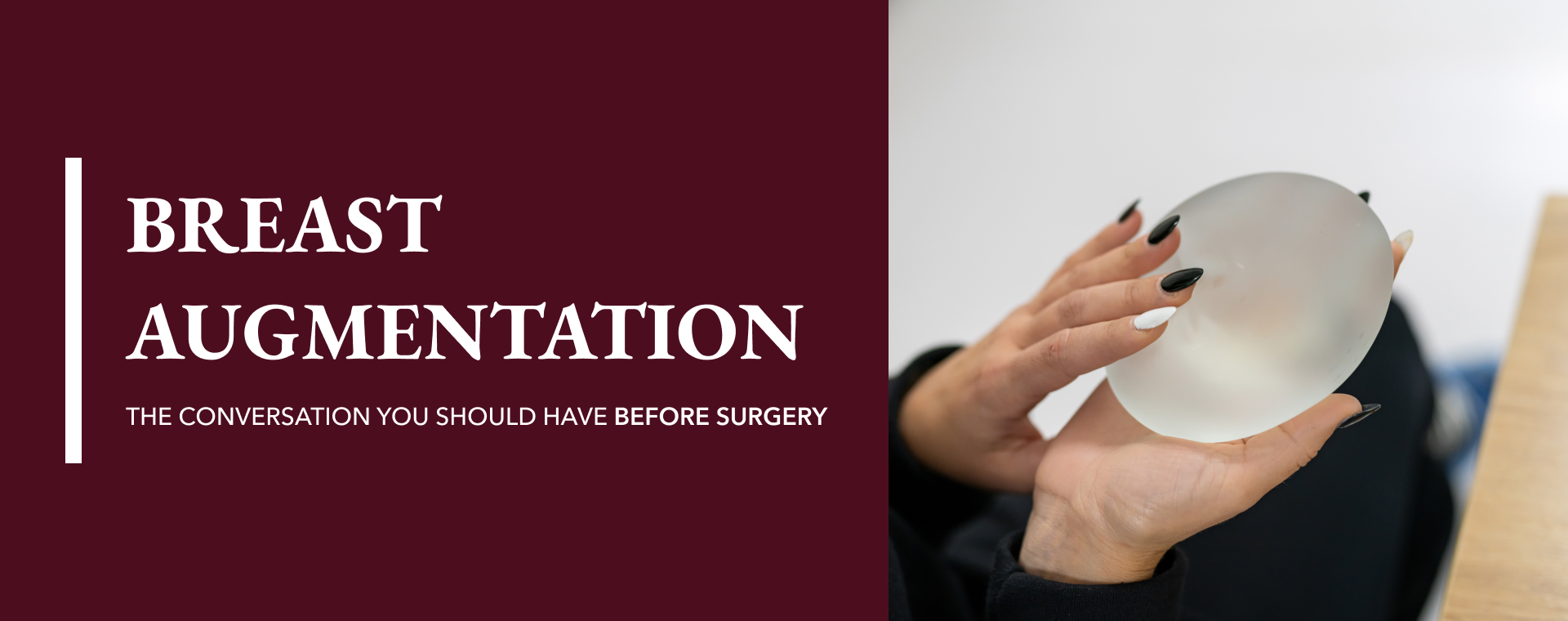
I believe implant sizers are one of the best ways to communicate a patient’s wishes. This is often the Goldilocks moment.
Not too big.
Not too small.
Just right.
That moment is important because it turns an abstract wish into something we can see, discuss, and refine together.
Why I Use 3D Imaging Before Breast Augmentation
After sizing, I follow up with three-dimensional photographic simulation using Vectra imaging. This allows the patient to see a likely surgical result from multiple views.
No imaging system can promise an exact result, but it does create a more transparent conversation. It helps us look at proportions, implant profile, breast position, and how a chosen implant may complement the patient’s frame.
This is the most transparent method I know to help patients participate in choosing their post-operative result.
What We Discuss Before Surgery
Most of the time I spend with a breast augmentation patient is not spent “selling” surgery. It is spent discussing the details that determine whether surgery is appropriate and how we can make thoughtful decisions.
That includes a discussion of potential complications and how we try to avoid them.
We discuss whether a breast lift is needed. This is especially important for patients who have had children, breastfed, lost weight, or noticed sagging over time. An implant can add volume, but it does not reliably correct significant breast descent. Sometimes a lift is the more important part of the operation.
We discuss implant profile and how it affects shape, projection, and upper pole fullness. Patients may think they want a certain size, when what they really want is a certain shape or proportion.
We discuss the differences among available implants, including saline implants, silicone gel implants, and the various manufacturers. We discuss implant texture, feel, profile, warranty, and long-term considerations.
We discuss subglandular, submuscular, and dual-plane placement. Each has a role, but the right answer depends on the patient.
These conversations are much more effective before surgery than after.
Do Your Homework Before Breast Augmentation
My advice for future patients is straightforward: do your homework.
Learn enough to ask better questions. Bring photos, but understand that photos are a communication tool, not a guarantee. Be honest about what you want. Be honest about what worries you. Ask about the surgeon’s experience, approach, complication management, and revision philosophy.
It is also reasonable to recognize that plastic surgeons are incentivized to perform surgery. That does not mean surgery is wrong. It does mean you should feel comfortable asking why a recommendation is being made.
If you feel you are being pushed into a size, a procedure, or a timeline, ask why.
A good doctor-patient relationship should be based on open discussion and complete transparency. Anything less can lead to problems.
The Third Time Should Not Have to Be the Charm
Undesirable outcomes and complications can occur even under the best circumstances and with the best intentions. Every surgeon who has operated long enough understands that.
But there is no excuse for a patient going into breast augmentation without a clear understanding of implant placement, implant size, long-term risks, alternatives, and realistic expectations.
The third time may be the charm, but it should not take three surgeries for a patient to finally feel heard, informed, and properly guided.
Breast augmentation can be a very satisfying procedure when it is planned carefully, discussed honestly, and tailored to the individual patient. The goal is not simply larger breasts. The goal is a result that fits the patient’s body, expectations, and life.
That begins with the conversation before surgery.
Frequently Asked Questions About Breast Augmentation
What should I know before getting breast augmentation?
Before breast augmentation, patients should understand that the procedure is not just about choosing an implant size. Important decisions include implant type, implant profile, implant placement, incision location, whether a breast lift is needed, and how to manage realistic expectations. A thorough consultation should include a candid discussion of risks, benefits, alternatives, and long-term considerations.
Is it better to place breast implants above or below the muscle?
Neither option is automatically better. Placing implants above the muscle, below the muscle, or in a dual-plane position can all be appropriate depending on the patient’s anatomy, breast tissue, goals, and implant choice. The best placement is the one that fits the patient’s body and desired result after a careful discussion with the surgeon.
Can capsular contracture happen with any breast implant placement?
Yes. Capsular contracture can occur whether an implant is placed above or below the muscle. While surgeons take steps to reduce risk, no approach eliminates the possibility completely. This is one reason patients should understand potential complications before surgery.
How do I choose the right breast implant size?
Choosing the right implant size should be a shared decision between the patient and surgeon. Implant sizers can be very helpful because they allow the patient to see and feel different options. For many patients, the goal is the “Goldilocks” result: not too big, not too small, but just right for their frame and goals.
Are 3D breast augmentation simulations accurate?
Three-dimensional imaging, such as Vectra, can be very helpful for visualizing possible results from different angles. It is not a guarantee of an exact outcome, but it can make the consultation more transparent and help patients better understand implant size, shape, and placement.
Will breast implants fix sagging breasts?
Breast implants add volume, but they do not reliably correct significant sagging. If the breast tissue or nipple position has dropped, a breast lift may be recommended with or instead of implants. This is especially common after pregnancy, breastfeeding, weight loss, or natural aging.
What questions should I ask my plastic surgeon before breast augmentation?
Patients should ask about implant type, implant placement, incision options, recovery, risks, revision surgery, capsular contracture, scarring, and whether a lift may be needed. They should also ask why a specific implant size or surgical plan is being recommended.
What is the most important part of a breast augmentation consultation?
The most important part is honest communication. A patient should feel heard, informed, and never rushed. The surgeon should understand the patient’s goals and explain what is realistic, what choices need to be made, and what risks exist before surgery takes place.